
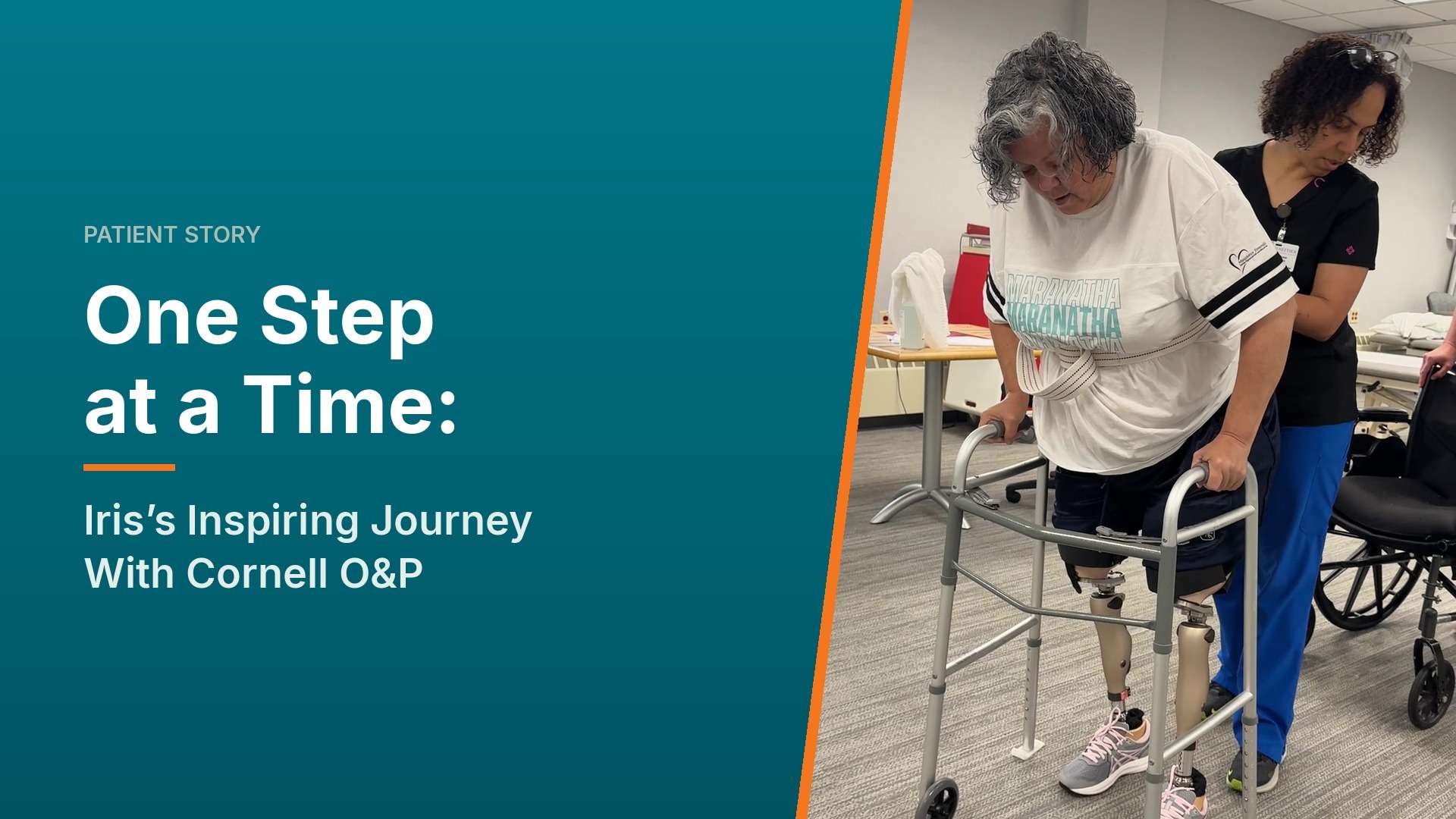
Every person’s journey with prosthetics is different. For Iris, a 62-year-old bilateral transfemoral amputee, the path toward walking with greater confidence has involved patience, determination, and finding the right solutions for her individual needs.
At Cornell O&P, Iris’s journey highlights the importance of personalized prosthetic care, appropriate technology, and ongoing support. From navigating the challenges of her initial prostheses to learning to walk with Kenevo microprocessor-controlled knees, she continues working toward her mobility goals one step at a time.
Her story is a reminder that progress looks different for everyone, and that every person’s goals deserve to be approached with care, respect, and encouragement.
Navigating the Challenges of Prosthetic Walking
As a bilateral transfemoral amputee, meaning she has an amputation above each knee, Iris faces unique challenges when it comes to walking with prostheses.
Initially, she used short, rigid prostheses known as stubbies. While these can provide a useful mobility option for some individuals, Iris found walking with them physically demanding. Walking with bilateral above-knee prostheses puts tremendous strain on her cardiovascular system. This made finding a suitable prosthetic solution especially important.
Iris’s experience reflects how individual health needs, comfort, and energy requirements can influence a person’s prosthetic journey. Rather than following a one-size-fits-all approach, her care team continued exploring options that could better support her mobility goals.
Exploring New Possibilities With Kenevo Microprocessor-Controlled Knees
An important step in Iris’s journey was transitioning to Kenevo microprocessor-controlled knees.
These prosthetic knees use microprocessor technology to regulate knee resistance, helping support controlled movement and stability. Unlike mechanical knees, the Kenevo knees were programmed to best meet her needs. They provided stability to prevent knees from buckling but still flexed to allow her to swing the feet and clear the ground. Learning to use the new knees required practice, instruction, and adjustments to Iris’s walking pattern.
As part of her training, she practices a specific gait pattern that triggers an audible beep telling her that the knee is ready to bend. The flexed knee provides needed ground clearance and avoids catching the toe and falling.
Learning the correct walking pattern takes time, and each training session provides an opportunity to become stronger and more familiar with the technology. Iris understands that this is a long process and remains strongly motivated with a focus on her individual goals.
Her experience demonstrates the importance of matching prosthetic technology to a person’s needs and providing the training and support necessary to use it effectively.
For a prosthetics company like Cornell O&P, this means looking beyond the device itself and considering the individual, their health, their daily activities, and what they hope to achieve.
Supporting Comfort and Fit With CJ Sockets
Another important consideration in Iris’s care is maintaining a consistent prosthetic socket fit.
Changes in fluid levels associated with her heart-related health challenges affect her residual limb volume. These changes directly influence how the prosthetic socket fits, making adjustments and appropriate socket solutions an important part of her ongoing care.
Iris uses CJ User Adjustable volume Sockets, a patented socket technology designed to accommodate changes in limb volume and maintain a consistent fit.
The socket is an essential part of a prosthesis because it connects the residual limb to the prosthetic device. Its fit can influence comfort, stability, and how effectively a person can use their prosthesis during daily activities.
By considering both knee technology and socket fit, Iris’s prosthetic care takes a broader approach to her individual needs. The goal is to help her work toward greater comfort, stability, and mobility as she continues her rehabilitation.
Her experience illustrates why personalized assessment and ongoing follow-up are important when selecting and adjusting prosthetic components.
Progress Looks Different for Everyone
Prosthetic rehabilitation is a personal process. Each individual brings different goals, health considerations, experiences, and needs to their journey. Progress may involve learning a new movement, improving balance, building confidence, or finding equipment that better supports everyday activities.
For Iris, learning to use Kenevo microprocessor-controlled knees represents another stage in her ongoing work toward greater mobility.
Her journey is not about meeting a particular timeline or comparing her progress with anyone else’s. It is about identifying what works for her, adapting to new technology, and continuing to pursue the goals that matter to her.
At Cornell O&P, we recognize that meaningful progress is personal. As a prosthetics company, we believe in taking the time to understand each patient’s needs and helping them explore solutions that align with their circumstances and goals.
A Journey Built on Individual Goals and Ongoing Support
Iris’s story highlights the importance of perseverance, personalized prosthetic care, and a willingness to explore new possibilities.
From navigating the challenges of walking with stubbies to learning a new gait pattern with Kenevo microprocessor-controlled knees, she continues to work toward her mobility goals with the support of her prosthetic care team.
Her journey also reminds us that there is no single definition of progress. Every person’s experience is unique, and each achievement has meaning within the context of their own goals and circumstances.
At Cornell O&P, we are committed to supporting individuals throughout their prosthetic journeys with thoughtful care, appropriate technology, and attention to their individual needs.
Every journey is different. Every goal matters. And every step forward deserves to be recognized.


